Private landlord disrepair: why it’s hard to find a surveyor

Private landlord disrepair: why it’s hard to find a surveyor

Private landlord disrepair: why it can be hard to find a surveyor (and how to make it straightforward)

If you rent from a private landlord and the property has disrepair issues (damp, leaks, defective heating, unsafe electrics, etc.),
you may be surprised at how hard it can be to find a surveyor who will take it on quickly.

This article explains why that happens and gives you two practical checklists:
(1) what to prepare before contacting a surveyor, and (2) what to do before the inspection to avoid delays.

If you need a Part 35 compliant Housing Disrepair Report (photographs and Scott Schedule included as standard) see:
Housing Disrepair Reports.
For expert evidence more broadly, see:
Expert Witness Reports.
To speak to us (Altrincham or Liverpool), use:
Contact.

Note: This blog is general information only. It is not legal advice. A survey inspection is visual and non-intrusive and does not include specialist testing unless separately instructed.


Why it’s often difficult to find a surveyor for private landlord disrepair

1) Evidence standards are higher than people expect

Disrepair work isn’t just “spot the damp”. A proper report often needs to document the defects clearly, consider likely causes, explain likely remedial works,
and present it in a format that can stand up to scrutiny (especially where a claim is being pursued).

2) Independence is essential

A surveyor must remain independent and objective. Some enquiries start with “I need you to say X” (e.g., “the landlord is 100% at fault” or “the property is uninhabitable”).
That’s a red flag. A competent surveyor will only state what the evidence supports, with limitations explained.

3) Access, cooperation, and logistics are frequently messy

Private landlord cases commonly involve:

  • unreliable access arrangements (agent/landlord/tenant availability)
  • repairs happening last-minute (changing what can be observed)
  • restricted areas (locked rooms, blocked loft hatch, full cellars)
  • uncertainty over who will allow entry and when

If the surveyor can’t inspect properly, the report may be limited or delayed.

4) “Scope creep” is common

A disrepair instruction can quickly expand from “please inspect damp” into “assess everything, estimate costs, confirm legal liability, and write letters”.
Many surveyors avoid this work because the scope is often unclear at the point of enquiry.

5) Timing and urgency can be unrealistic

Tenants are often (understandably) frustrated and want immediate action. Surveyors have to balance urgency with safe access, adequate inspection time, and correct reporting standards.
The faster you can provide clear information up front, the faster the job can usually be booked and completed.


Checklist 1: What to prepare before contacting a surveyor

This is the fastest way to get a meaningful response (and avoid multiple back-and-forth emails).
Have this ready before you call or submit an enquiry.

  • Who you are: tenant / landlord / solicitor / representative (and the best contact details).
  • Property basics: full address + property type (flat/house), approximate age (if known), and whether it’s leasehold (if known).
  • Access facts: who controls access, who can be present, any restrictions (pets, keys, entry codes, vulnerable occupants).
  • Defect summary (short and factual): list the main issues by room (e.g., “bedroom 2 ceiling staining”, “kitchen mould to external wall”, “boiler not heating”).
  • Timeline: roughly when each issue started and whether it is constant or intermittent (e.g., “worse after heavy rain”).
  • What has already happened: any repairs attempted, contractors attended, leaks “fixed” then returned, or recurring problems.
  • Communication log: dates you notified the landlord/agent and any responses (screenshots/letters helpful).
  • Photos/videos: clear images with dates where possible (wide shot + close-up; include any staining/peeling/mould patterns).
  • What you need the report for: early viability view / pre-action steps / Part 35 compliant report / joint inspection, etc.
  • Any immediate hazards: active leaks near electrics, suspected structural instability, obvious unsafe wiring. (If there is immediate danger, contact the relevant emergency services/utility provider first.)

If you want a Part 35 compliant report and Scott Schedule/photographs included, start here:
Housing Disrepair Reports.


Checklist 2: What to do before the inspection (to avoid “NI” areas and delays)

Disrepair inspections are still visual and non-intrusive. The surveyor needs safe, reasonable access to observe defects and likely causes.
Do these steps 24–48 hours before the appointment where possible:

  • Clear access to walls/skirtings: move furniture away from affected areas (especially external walls with damp/mould).
  • Make the loft hatch accessible: clear the area below it and ensure it can be opened safely (if there is a hatch).
  • Unlock all relevant areas: bedrooms, storage rooms, garages/outbuildings, boiler cupboards, meter cupboards.
  • Ensure utilities are on (if safe): electricity/gas/water available so systems can be visually checked where appropriate.
  • Gather paperwork in one place: any repair invoices, landlord/agent correspondence, previous reports, guarantees, servicing records (if you have them).
  • Don’t “tidy away” the evidence: you can clean for hygiene, but avoid redecorating/painting over defects right before inspection if the aim is to document current condition.
  • Note where/when it happens: if staining worsens after rain, note dates and weather events; if mould worsens after cooking/showering, note ventilation use.
  • List key questions you want answered: (a) what is the likely cause, (b) what remedial works are likely, (c) what should be prioritised, (d) what further investigation is justified.
  • Make attendance clear: confirm who will be present and provide a phone number for access on the day.

What a surveyor can typically provide (and what they can’t)

  • Can: identify visible defects, comment on likely causes, explain risks and priorities, recommend proportionate next steps, and set out remedial works at an appropriate level for the instruction.
  • Can’t: give legal advice, guarantee hidden areas, or replace specialist testing where that is required (e.g., electrics/gas testing, invasive moisture investigation) unless separately instructed.

Want to proceed?

If you need a Part 35 compliant Housing Disrepair Report (including Scott Schedule and photographs), you can request a quote here:
Housing Disrepair Reports.
If your matter requires expert evidence in wider proceedings, see:
Expert Witness Reports.

To speak to us (Altrincham or Liverpool):
Contact Torus Surveyors.


Note: This blog is for general information only and is not legal advice. Survey inspections are visual and non-intrusive and do not include specialist testing unless separately instructed.

How to read your HomeBuyer Report

How to read your HomeBuyer Report

LEVEL 2 – Your survey report: how to use the Condition Ratings and “What to do now” section

This guide explains how to read and use an RICS Home Survey – Level 2 (survey) report in a practical way.
Your report is written to help you make a reasoned and informed decision on whether to proceed, understand significant repairs or replacements,
and decide what further advice you should take before making a legal commitment to purchase.

Torus Surveyors Ltd operate from our Altrincham (Greater Manchester) head office and our Liverpool (Rodney Street) office.
If you’d like to book a Level 2 survey, see:
HomeBuyer Reports (RICS Level 2).

Important note: To get a balanced impression of the property, read the whole report.
The section titled “What to do now” is designed as your next-steps checklist, and we recommend you discuss the report with your surveyor if required.
Contact us here:
Contact.

A. About the inspection and report (what the survey does and doesn’t cover)

A Level 2 survey is a visual, non-intrusive inspection. This means we do not force or open up the fabric of the building.
We do not lift fitted floor coverings, move heavy furniture, remove stored items, or remove secured panels. Services are inspected visually where accessible,
but they are not subject to specialist testing.

The report will note where access or visibility restricted the inspection. If we are concerned about an area we could not inspect,
the report will recommend appropriate further investigation (before exchange where relevant).

B. Condition ratings (your prioritisation tool)

Your report uses Condition Ratings to help you prioritise maintenance and repairs. In addition, you may see an “R” marker (explained below).

  • Condition rating 3 – Defects that are serious and/or need to be repaired, replaced or investigated urgently. Delay can increase risk of safety issues or long-term damage.
  • Condition rating 2 – Defects that need repairing or replacing but are not considered serious or urgent. The property must be maintained in the normal way.
  • Condition rating 1 – No repair is currently needed. The property must be maintained in the normal way.
  • NI – Elements not inspected (often due to access, safety or visibility limits).

How to read the “Overall opinion” and the ratings summary

Start with the Overall opinion and the list of elements grouped by urgency. This is your quick snapshot:

  • All Condition rating 3 items: treat these as time-sensitive and decision-relevant.
  • NI items: these are “unknowns”. Read the limitation note and decide if access can be improved or if a specialist should be instructed.
  • Condition rating 2 items: build these into your early ownership budget and maintenance plan.

“R” – Documents we may suggest you request before you sign contracts

In your report, “R” is not a condition rating. It flags documents that we may suggest your solicitor requests
before you exchange contracts. Treat this as a conveyancing checklist and ensure your legal adviser has satisfactory evidence on file.

Examples of the types of documents commonly requested (where relevant to the property) can include approvals/consents,
guarantees/warranties, and servicing records for systems and installations.

H. Issues for your legal advisers (send this section to your solicitor)

Your report will include a section titled “Issues for your legal advisers”. This is where we highlight matters
your solicitor should investigate further (for example, confirming statutory consents, warranties/guarantees, servicing records,
and—for flats—management company responsibilities and documents).

Note: The surveyor does not act as a legal adviser and does not comment on legal documents.
The purpose of this section is to help your solicitor target the right enquiries.

I. Risks (don’t skip this section)

The Risks section summarises significant defects and issues that present risk to the building or grounds,
or a safety risk to people. Items with a Condition rating 3 are commonly highlighted here because they may represent a risk if not addressed.

If you intend to proceed, it is sensible to send the report to your legal advisers as soon as possible and draw attention to the Risks section.

K. What to do now (your action plan)

1) Further investigations and getting quotes

Before you make a legal commitment to buy the property, you should obtain reports and quotations for the repairs and further investigations identified in the report.
The cost of repairs may influence the amount you are prepared to pay.

  • Obtain at least two written quotations from experienced, properly insured contractors.
  • Ask for references and set out in writing exactly what you want priced.
  • If specialist inspections are recommended (e.g., electrics/gas/roofing/drainage, as appropriate), arrange these before exchange.

2) Turn the report into three simple lists

  • List A (Urgent): all Condition rating 3 items, plus any “uncertain” areas needing further investigation.
  • List B (Legal): all “R” document requests and the items raised in “Issues for your legal advisers”.
  • List C (Maintenance): Condition rating 2 items you plan and budget for after completion.

3) If anything is unclear, speak to the surveyor

We can explain the reasoning behind the rating, the likely next step (repair vs further investigation),
and how to prioritise multiple issues sensibly.
Contact:
Contact Torus Surveyors.

When a Level 3 survey may be more appropriate

A Level 2 survey is often suitable for conventional properties in reasonable condition. If the property is older, unusually constructed,
significantly altered, or clearly in poor condition, a more detailed inspection may be appropriate.
See:
Building Surveys (RICS Level 3).

Need a valuation instead (or as well)?

If you require an independent valuation for a specific purpose, see:
Home Valuations.

Speak to a surveyor (Altrincham or Liverpool)

Altrincham (Head Office): 0161 929 7892
Liverpool: 0151 665 0885
Email: info@house-survey.co.uk


Note: This blog is for general information only. It is not legal advice. A Level 2 survey is a visual inspection and does not include specialist testing.
Always read your full report and follow any recommendations for further investigation before making a legal commitment to purchase.

Choosing the Right House Survey in 2026

Choosing the Right House Survey in 2026

Choosing the Right House Survey in 2026: Level 1 vs Level 2 vs Level 3 (and why many buyers choose Level 2)

Buying a home is usually your biggest purchase — and small hidden defects can become expensive quickly.
Torus Surveyors Ltd are residential Chartered Surveyors and RICS Registered Valuers with a head office in
Altrincham (Greater Manchester) and a second office in Liverpool (Rodney Street).
We cover surveys and valuations across Greater Manchester, Merseyside and Cheshire.
If you’re unsure which survey to choose, this guide explains the differences between the three RICS Home Survey levels and how to get the most value from your inspection.

Start here for an overview of our survey services:
RICS Home Surveys.

Your mortgage valuation is not a survey

A lender’s valuation is primarily for the lender. If you want a clear, practical understanding of condition and risk before you commit,
you typically need a survey report that’s commissioned for you.

The three levels (plain English)

Level 1 (Condition Report): a basic condition snapshot

Level 1 is designed for conventional, typically newer properties that appear in good condition.
It describes condition, flags risks and urgent defects, but it will generally not give advice on how to manage defects through repairs or ongoing maintenance.
If you need more actionable guidance, many buyers find Level 2 is the more useful starting point.

Learn more:
RICS Home Survey Level 1 – Condition Reports.

Level 2 (HomeBuyer Report): the “default” choice for many conventional homes

Level 2 is typically best suited to conventional properties in reasonable condition and simpler in form/layout (for example, not heavily altered or extended).
It provides more detailed information than Level 1, including ideas about future repairs/maintenance that may be required.
Level 2 can usually be instructed as survey only, or survey and valuation (where a valuation is required and agreed in advance).

If you’re deciding between Level 1 and Level 2, a good rule of thumb is:
if you want guidance you can use to budget, prioritise, and negotiate, Level 2 is often the more appropriate choice.

Learn more:
RICS Home Survey Level 2 – HomeBuyer Reports.

Level 3 (Building Survey): for older, altered or higher-risk properties

Level 3 is the most comprehensive option and is usually the right choice for older buildings, properties in below-average condition,
unusual construction, or homes that have been significantly altered (extensions, conversions, structural changes), and where you want deeper analysis and advice on defects, repairs and maintenance.

Learn more:
RICS Home Survey Level 3 – Building Surveys.

What “non-intrusive inspection” really means

RICS Home Surveys are visual inspections. Surveyors do not carry out tests on the building fabric or services,
and access is limited to what is safe and reasonably available at the time of inspection.
That’s why choosing the right level matters: the more complex or higher-risk the property, the more you benefit from the added detail and context in the higher levels.

How to get maximum value from your survey

  • Access: make sure the loft hatch, meter cupboards, garages/outbuildings and rear garden areas are accessible where possible.
  • Paperwork: gather any planning/building control approvals, completion certificates, guarantees, and recent electrical/gas documentation (if available).
  • Tell us your concerns: recurring damp, staining, cracking, roof leaks, previous structural works, drainage issues, or historic flooding.
  • Ask two practical questions: “What’s the most urgent risk in the next 12 months?” and “What’s likely to drive costs over the next 5 years?”

Survey or valuation: make sure you’re booking the right service

Sometimes you don’t need a condition survey — you need a valuation for a specific purpose. Useful starting points:

Speak to a surveyor (Altrincham or Liverpool)

If you tell us the property age/type, whether it’s been altered, and anything you’re concerned about, we can help you choose a suitable level.
Full contact details are here:
Contact Torus Surveyors.

Altrincham (Head Office): 0161 929 7892
Liverpool: 0151 665 0885
Email: info@house-survey.co.uk

‘Weird Stuff’ Surveyors See

‘Weird Stuff’ Surveyors See

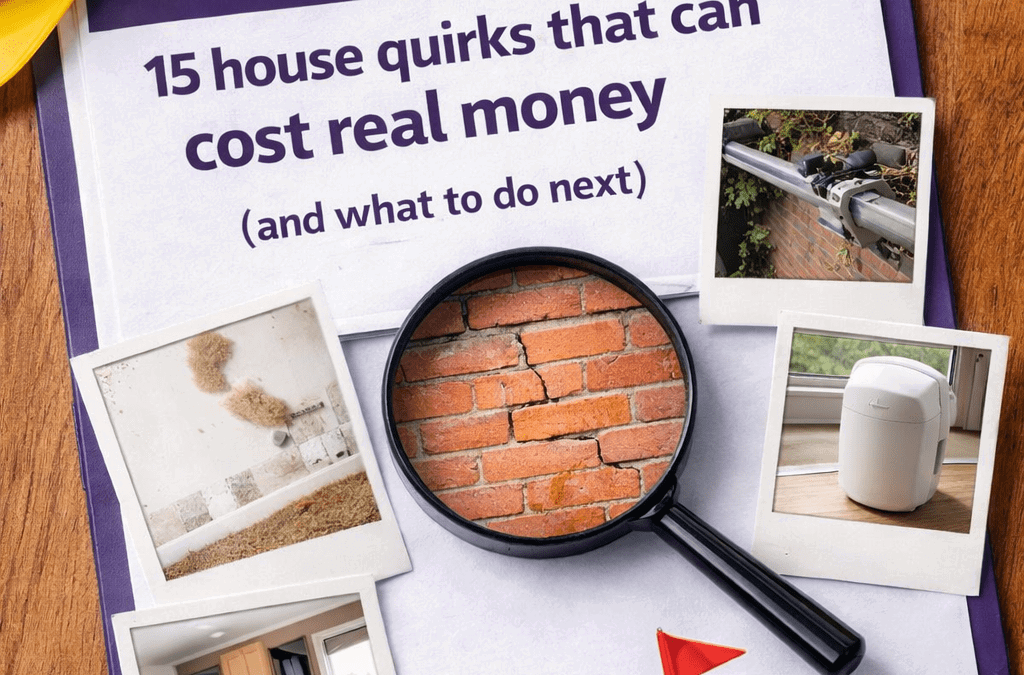
The ‘Weird Stuff’ Surveyors See: 15 house quirks that can cost real money (and what to do next)

Houses are full of surprises. Some are harmless. Others are the early warning signs of repairs that can cost far more than people expect.
This post is a light-hearted look at 15 common “quirks” surveyors come across — and the practical next step if you spot them.

Torus Surveyors Ltd operate from our Altrincham (Greater Manchester) head office and our Liverpool (Merseyside) office.
If you’re buying a property and want an informed view of condition and risks, see:
HomeBuyer Reports (RICS Home Survey Level 2)
and
Building Surveys (RICS Home Survey Level 3).

Important note: A survey is a visual, non-intrusive inspection. Surveyors do not “open up” the building fabric or test services like a specialist contractor would.
This article is general information only (not legal advice). If you need tailored guidance, speak to a surveyor:
Contact.

Quick contents

  1. The “fresh paint perfume”
  2. Random extractor fans that don’t vent outside
  3. A dehumidifier “included in the sale”
  4. The mystery stain that comes back after rain
  5. Cracks that look like a staircase
  6. The “bouncy” floorboard trampoline
  7. A loft hatch that’s blocked (or “doesn’t exist”)
  8. The roof that’s “fine” but the gutters are jungles
  9. A cellar that smells like an old pub
  10. A garage conversion that feels like a fridge
  11. Multiple layers of flooring like geological strata
  12. A chimney breast that’s been “removed” (sort of)
  13. A bathroom fan that triggers the disco lights
  14. The “new boiler” with no paperwork
  15. A loft conversion with a ladder that inspires fear

1) The “fresh paint perfume”

Fresh paint isn’t suspicious by itself — but heavy paint smell plus recently repainted patches (especially low down on walls) can sometimes indicate attempts to tidy up staining.
The key is to look for patterns (e.g., repeated patches, matching marks on skirting, or a “tide line” effect).

Next step: If it’s a conventional property, a Level 2 survey can help identify likely causes and whether further investigation is sensible.

2) Random extractor fans that don’t vent outside

A fan that recirculates or vents into a loft void can contribute to condensation and mould. It can also be a sign of DIY alterations.

Next step: Ask where it vents to, check for obvious signs of poor ventilation, and budget for improvements if needed.

3) A dehumidifier “included in the sale”

Sometimes it’s just convenience. Sometimes it’s a clue that a room is regularly damp or poorly ventilated.
If the vendor has one in every room, that’s worth paying attention to.

Next step: Treat it as a prompt to investigate ventilation, heating patterns, and any visible damp-related symptoms.

4) The mystery stain that comes back after rain

Stains that change with weather can point towards rainwater goods, roof coverings, flashings, or external wall defects.
“It only happens in heavy rain” is still a defect — it’s just intermittent.

Next step: Check gutters/downpipes and external wall condition. A survey can help you understand the likely route of moisture ingress and the urgency.

5) Cracks that look like a staircase

Step cracking in brickwork can occur for various reasons, from historic movement to localised issues (including drainage-related problems).
The context matters: crack width, recent changes, location, and associated distortion.

Next step: Don’t panic, but don’t ignore it. A Level 3 survey is often more suitable where movement is a key concern or the property is older/altered.

6) The “bouncy” floorboard trampoline

Springy floors can be simple (loose boards/joists) or more significant (subfloor ventilation issues, moisture, or decay),
particularly in older properties with suspended timber floors.

Next step: Check for ventilation grilles externally (where visible), ask about past damp/rot treatment, and consider whether a more detailed survey is appropriate.

7) A loft hatch that’s blocked (or “doesn’t exist”)

If the loft can’t be accessed safely, it may be recorded as not inspected. Loft voids can contain important clues: insulation levels, ventilation, and roof structure condition.

Next step: If you can (before exchange), arrange safe access or a specialist inspection. If you’re commissioning a survey, make access as easy as possible on the day.

8) The roof that’s “fine” but the gutters are jungles

Gutters full of moss and debris are a common cause of damp staining and deterioration. Even a good roof can cause problems if rainwater isn’t controlled properly.

Next step: Budget for clearing/repairs and check for staining to fascias, soffits, and internal upper walls.

9) A cellar that smells like an old pub

Cellars/basements can be perfectly usable, but odour, staining, and poor ventilation can indicate persistent moisture.
The “musty” smell is often the first complaint.

Next step: Treat basements as higher-risk elements. A Level 3 survey is commonly more appropriate for older property types with cellars.

10) A garage conversion that feels like a fridge

Converted garages often suffer from poor insulation, damp risk, and ventilation issues. Sometimes the conversion is informal or incomplete.

Next step: Ask about approvals and check for signs of cold bridging/condensation. Your solicitor should verify relevant documentation where applicable.

11) Multiple layers of flooring like geological strata

Layering floors (laminate over tile over old vinyl, etc.) can hide unevenness, historic damp staining, or simply create trip hazards and threshold issues.

Next step: Expect some investigative uplift when renovating (subject to permissions/tenure). A survey can flag where floors appear uneven or compromised.

12) A chimney breast that’s been “removed” (sort of)

Removing chimney breasts can be done correctly — but partial removals can sometimes leave inadequate support, cracking, or unusual alterations.
Sometimes you see odd boxing-in or “floating” bits of structure that invite questions.

Next step: If alterations look significant, a Level 3 survey is usually more suitable, and your solicitor should confirm approvals where relevant.

13) A bathroom fan that triggers the disco lights

Odd electrical behaviour (lights dimming, fans pulsing, random tripping) can indicate wiring issues, poor connections, or non-standard DIY alterations.
A survey is not an electrical test, but it can flag visible concerns and recommend appropriate further inspection.

Next step: Where concerns exist, instruct a qualified electrician for testing before exchange (where possible).

14) The “new boiler” with no paperwork

A recently replaced boiler can be positive — but lack of servicing records, installation certificates, or warranties can create delays and uncertainty.

Next step: Treat this as a “documents to request” issue for your solicitor, and arrange specialist checks if advised.

15) A loft conversion with a ladder that inspires fear

Loft conversions are common, but access arrangements, fire safety provisions, and evidence of approvals are frequently misunderstood by buyers.
If the conversion is central to why you’re buying the property, you want clarity early.

Next step: Your solicitor should confirm relevant consents/certification. A more detailed survey may be appropriate depending on age, complexity and visible condition.


So… which service should you book?

What to do now (a simple buyer checklist)

  1. Prioritise safety and urgency: anything that looks serious or uncertain should be investigated before exchange.
  2. Get the right specialist checks (only where justified): electrics, gas, roofing, drainage, damp/ventilation, etc.
  3. Get written quotes from appropriately qualified and insured contractors so you can budget realistically.
  4. Use your solicitor effectively: where the issue is approvals/certification/warranties, ask for documents early.
  5. Speak to your surveyor if you want the findings translated into clear priorities.

If you’d like to book a survey or discuss which level is appropriate for your property, contact us here:
Contact Torus Surveyors.

Need a valuation instead (or as well)?

If you require an independent valuation for a specific purpose, see:
Home Valuations.


Note: This blog is for general information only. It is not legal advice.
A survey is a visual inspection and does not include specialist testing. Always read your full report and follow any recommendations for further investigation before making a legal commitment to purchase.

Help to Buy: The importance of a RICS valuation

Help to Buy: The importance of a RICS valuation

The Help to Buy scheme could help you get a foot on the property ladder if you’re a first-time buyer. And, unlike a homebuyer survey, a RICS valuation will establish a property’s market value when it’s time to sell up. Discover why a RICS valuation is so important to the Help to Buy scheme and how you can find a building surveyor in Altrincham to complete the process.

What is Help to Buy?

Help to Buy is a government-backed loan scheme launched in England and Wales in April 2013. Initially targeted at first-time buyers, it also offers help to existing homeowners. The loan covers the purchase of new build properties only. 

As a buyer, you must have a minimum 5% deposit and be eligible for the scheme. The government or housing association will loan you the rest of the money you need.  It’s important to note that Help to Buy is a shared ownership scheme and that purchase prices are capped regionally. 

Help to Buy is not a mortgage. Instead, your loan will only cover a portion of the property’s value. So if you decide to sell, the amount you repay will depend on whether your property is worth more or less than when you bought it. 

Who is eligible for Help to Buy?

To be eligible for a Help to Buy loan, you need to meet the following criteria:

  • Be a first-time homebuyer aged 18+ who has never previously owned land or property.
  • Buy a new-build property as your principal residence.
  • Live in the property and not rent it out.

You must also buy a property from a builder registered with the scheme.

What is a RICS Help to Buy valuation?

Unlike a homebuyer survey, you need a RICS Help to Buy valuation when you decide to sell, repay your loan, or part pay to increase your share in the property.

A RICS Help to Buy valuation establishes the actual market value of your property. This valuation is then used to establish how much you’ll need to repay. A Help to Buy valuation is valid for three months to reflect the housing market.

When do I need a RICS Help to Buy valuation?

There are two scenarios in which you might need a RICS Help to Buy valuation:

Selling your property

If you decide to sell your property, you’ll need to repay your Help to Buy loan in full. Your loan repayment will depend on the RICS valuation or the purchase price, whichever is higher.

Staircasing

You can also choose to part-pay your loan to increase your share in the property. This process is known as staircasing and allows you to remain in your home. Again, knowing the market value with a RICS Help to Buy valuation could help you make repayments at the best time.

An accurate RICS valuation ensures that you’re not financially benefiting from the Help to Buy scheme and the government is getting a return on its investment.

What do I need for a Target Help to Buy valuation?

All Help to Buy loans are managed for the government by Target, a private company. They will determine the repayment figure for your loan based on market value.

Your RICS Help to Buy valuation must be completed to meet Target’s Help to Buy criteria, including:

  • Valuation by a RICS-certified Help to Buy surveyor with knowledge of the local area and expertise in Help to Buy valuations.
  • Completed by an independent surveyor not connected to the estate agent or yourself.
  • A dated report carried out per the Red Book RICS Valuation standards.

A copy of the report with its inspection date must be submitted to Target as part of any Help to Buy redemption.

What does a RICS Help to Buy valuation include?

Your RICS Help to Buy valuation must be carried out by a certified surveyor and will include the following:

  • An assessment of the property’s interior and exterior, considering age and condition.
  • Overview of the presence and absence of desirable features, including off-road parking, gardens etc.
  • Overview of location, construction methods and property size.
  • Details and sale price of three similar properties in the local area that have sold within the last year.
  • An accurate market valuation of your property.

How do I find a RICS surveyor?

Whether you need a homebuyer survey or RICS Help to Buy valuation, you need a surveyor who’s accredited by the Royal Institute of Chartered Surveyors (RICS). Your home is the single most significant investment you make, so using an accredited surveyor will give you peace of mind.

When choosing your RICS Help to Buy valuation surveyor, make sure their work is Target-compliant:

  • Check they have in-depth knowledge of the local area and expertise in Help to Buy valuations.
  • Ensure they’re independent of anyone involved in the buying and selling process.
  • Check their reputation through website testimonials and by asking family and friends.
  • Finally, ensure they have experience valuing new build properties.

Torus Chartered Surveyors for Help to Buy valuations

At Torus Chartered Surveyors, we can deliver a Help to Buy valuation that helps you sell or staircase your property. So if you’re looking for a valuation or homebuyer survey, contact us to find a RICS-certified building surveyor in Altrincham today.


6 Common Property Defects To Watch Out For

6 Common Property Defects To Watch Out For

While buying property is likely to be the best investment you make in your life, there’s an element of financial risk too. Once your home’s yours, it’s yours – meaning it’s your responsibility to fix anything that goes wrong. Depending on the issue, this can often be rather costly!

This is why it’s so important to spot property defects before you go through with the purchase. Knowing what you have in store, you’ll be able to budget for any work that needs doing, and maybe even negotiate the price of the property. To ensure you’re fully in the know, a homebuyer survey from a trusted building surveyor is key – but it certainly doesn’t hurt to brush up on the main things to look out for.

Inadequate ventilation

Modern repair techniques often encourage the reduction of natural ventilation into living accommodation as a means of improving energy efficiency,  it is often harmful to reduce ventilation into older buildings. Reduced ventilation can give rise to damp, condensation and timber decay.


When windows are replaced and efforts are made to reduce air flow from outside into the property and vice versa there is a real danger that condensation problems can occur in an old house. This should be considered when all repair works are undertaken.


Without proper ventilation, moisture can’t evaporate – so even if you can’t see the effects right now, you will have problems sooner or later. This is one of the most common causes of condensation and damp in older properties.  

How do you assess the ventilation? As a starting point, check that the roof has vents, windows for trikle vents, have any unused chimney breasts been vented, are there extract fans in the bathrooms and kitchens. More sophisticated Positive Input Ventilation (PIV) system are another great way of improving ventilation.  


Mould growth is often a tale tale sign of dampness caused by condensation.  

Dampness 

Damp can be caused by multiple building and plumbing problems that allow moisture into the property. It might be a result of poor ventilation, a leaking roof, defective weatherproofing, failing appliances, failed DPCs or even salt contamination of plaster or brickwork.


As problems go, the signs of dampness are relatively easy to spot. Watch out discoloured patches on walls and ceilings, salts forming on plaster and deterorated plaster. 


Roof damage

The roof is a fairly forgettable part of a property once you’re indoors – and if it’s in good working order, you’ll rarely think about it at all. But if it’s damaged, it’ll soon have a domino effect on lots of other elements of the property, from rising energy bills to hazards surrounding the house.


Again, spotting any moisture inside the home is a telling sign that something isn’t right – whether that’s leaks in the attic or the sounds of dripping water. Displaced tiles in the garden should also be a serious concern. Loose ridge and hip tiles are a common culprit as are flat roofs and sloping valleys. 


Structural movement

Structural movement is very common in buildings and normally not something to be overly concerned by, slight cracking is often caused by relatively benign items such as slight temperature changes and associated thermal movement – but it can be more serious when it’s caused by progressive foundation movement, cavity wall tie failure or inadequate support above openings. In most instances it is wise to seek the advise of a Chartered Surveyor


Cracks in the wall, tilting chimney stacks or gaps where walls and floors should join are all symptoms of structural movement. Leave them unattended and the house will eventually become dangerous and uninhabitable, so it’s best to deal with issues in the earliest instance.


Incorrectly fitted windows or doors

You want to keep the outside out, and the inside in – otherwise you’ll have endless ongoing problems with temperature control, and sky-high energy bills.

When you visit the property, drafts might be instantly apparent when you stand near the windows and doors, so keep this in mind as you walk around.


Poor drainage

Inadequate drainage doesn’t just result in unsightly leaks –  it can cause serious damage to the structure of the house. Over time, the pressure of water draining too close to the property will lead to cracks in the foundations, plus mould, dampness and a whole other number of problems. Defective, leaking drains are one of the most common causes of subsidence in Manchester’s housing stock


Keeping an eye out for these surface issues will help you identify some main problem areas early on – but please remember that some issues are much more easily disguised as they are often concealed underground. A Manchester building surveyor will tell you when to seek further advise.  

They can advise on the seriousness and cost of repairs, and give guidance on future maintenance.


Request an instant quote on your house survey from Torus Chartered Surveyors. Let us know the services you need, a few property details, and we will let you know how much your house survey will cost.”